The novel is set in rural and urban Lithuania in the Soviet postwar era, and as a friend said to me, “Why don’t you show some of those sites?”
So here are visuals of some of the settings in the novel.

1) My young Martin, the protagonist of the novel, is a youth living in a remote village called Lynežeris in 1947, in the south of the country, not far from the Byelorussian border. It’s a poor place where people live by subsistence farming. Here is a photo of one of the finer houses, taken a few years ago.

2) After years in the Gulag, in 1956, Martin finds himself in the city of Vilnius, where he goes looking for a job while walking down a major thoroughfare, called Vilnius Street. Here’s a modern picture of that street, all touristy now, but rather crumbling back then.

3) Martin applies for a job in a strange place, St. George’s church, which had been turned into a book depository for rare and forbidden books in the Soviet period. Here are a few photos. First the exterior, and then three interior shots of the bookshelves.


4) Kostas, the former village teacher in Martin’s youth, later becomes a famous writer who has an office in the fine Writers’ Union building. It was a former urban mansion with a modest exterior, but with some opulent decorations in the interior, including a grand staircase which Kristina will mount with complicating outcomes.


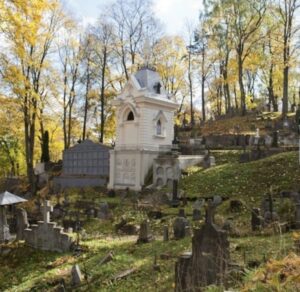
5) Kristina was adopted as a girl after being found shell-shocked in the Rasu cemetery, a short distance outside the city gate of Vilnius. It is a rambling old cemetery that runs over a couple of hills and a valley. It’s a place that comes alive on All Souls’ eve when people light candles and visit the graves of their dead.


6) Martin will have a basement apartment very close to the old food market, which continues to function to this day.

7) The Dawn Gate in the remnants of the old wall of Vilnius gets mentioned twice in the novel. First Martin and Kristina will simply go for a walk through the opening. Of the two photos, one shows the exterior and the other shows the interior, with the painting of Mary Mother of God behind a window on the second floor. Originally, another building stood outside the gate. Kostas describes this place going up in flames, as it really did near the end of the second world war.


8) Martin and Kristina will go for a walk down to what used to be called the Youth Park in the Soviet era. It’s a place where he will reveal some of his past. They walk by a fountain with elephants, but this fountain no longer exists in what is now called the Bernardinų Park.

9) Feeling burdened by the past, Martin and Kristina will go to an illegal bar for drinks in the old Užupis neighbourhood. This place is now very fashionable, but it was run down in the Soviet period.

And here’s a shout-out to Richard Martin-Nielsen, the former attaché at the Canadian embassy office in Vilnius. He suggested I do this last spring, before he moved on to another posting in Belgium. It only took me six months or so to get to it! Thanks, Richard, and good luck with the new assignment.