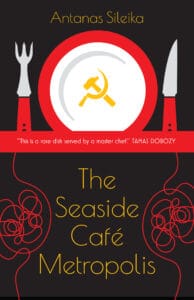
The Birth of the Seaside Café Metropolis

This comic novel is set in a Vilnius Café in 1959, a place with no seaside, and no metropolis, but there is indeed a café. It is a place where bohemians and artists gather during the Khrushchev political thaw of the times, but there is one difference between this fashionable café and other like it around the world. The KGB is listening through microphones set in the breadbaskets at each table.

My publicist described the novel as “A Gentleman in Moscow meets The Grand Budapest Hotel.” Writer Tamas Dobozy described the novel as “a culinary picaresque.” He said that because each chapter contains a Soviet-era recipe, ranging from Chicken Kiev to Napoleon cake.

So where did the idea for his novel come from? It all began at a real place, Vilnius’s historic Café Neringa
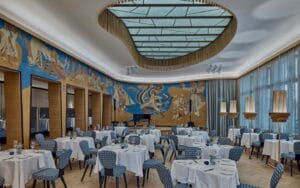
Above, the interior of the historic Café Neringa in Vilnius, both as it appeared in 1959 and as it is today

My introduction to the legendary Café Neringa in Vilnius, in the Lithuanian Soviet Socialist Republic, came in the summer of 1975. But I didn’t yet know the place was legendary.

I was the first of the family to visit Lithuania since my parents had fled the Red Army in 1944, so the trip was packed with latent emotion.

I had been turned back at the Polish border a week earlier due to a visa error and spent seven days trying to get the error corrected in Warsaw. Half a dozen of my Lithuanian relatives bought new bouquets of flowers daily and came to the train station but gave up after a week and went back to their homes in the northern city of Šiauliai. Now I was finally here in Vilnius, and they would soon come to meet me.

But in the meantime, there was the matter of breakfast.

Neringa was a very smart café, with a huge dining room and mosaics with a seaside theme, a middle section with a bar and fountain, and an intimate and charming street-front section. Not at all like the grimy train station cafés I had passed through in provincial Poland and the USSR.

The waitress handed me a thick menu book the size of a newspaper tabloid, with hundreds of items listed. There were many unusual dishes I thought I might try, so I asked first for the chicken in aspic.

The waitress told me they had none.

I looked down the menu and asked for sausages and eggs.

The waitress told me they had none.

This sort of exchange went on for half a dozen items with increasing exasperation on both parts until I came upon the unlikely availability of solyanka soup, a dish I’d never heard of at that time, made up mostly of cold cuts in a broth containing pickle juice. There was no coffee, but I could have tea with honey. The heavy black bread was good.

When my cousin’s husband came over to pick me up, he looked around the room with awe.

“What a place, eh?” he said after we’d made acquaintance.

“Sure,” I said. “But they didn’t have anything I asked for on the menu.”

“Did you choose from the checked boxes?”

It seemed that some Soviet menus contained all possible dishes, something like a Linnaean list with many categories and items, but only the ones available were marked by a pencil check in a tiny box. To the waitress, I had seemed like a moron, picking unavailable dishes. To me, the menu had looked like the culinary equivalent of a Potemkin village.

“This is the coolest place in town,” said Rimas. He didn’t get to the capital much, and he had clearly never been in this place before.

“What’s so special about it?”

“It’s a legend.”

“Legend for what reason?”

“Everybody who was somebody came to this place,” he said. “They still do.”

I didn’t know any of the Lithuanian somebodies in those days, neither the writers nor the artists, the musicians nor the actors. But I did get the idea that this was the iconic café of the city, as important locally as the Café de Flore or Deux Magots in Paris.

The café had been built in the late fifties during the brief Khrushchev thaw in the Soviet Union. Finally, bohemians and students had a stylish spot to go to, a place with jazz and wicked conversation. It was like all very cool places in the West, with this exception — there was a microphone at every table, and the KGB listened in to what all the bohemians were talking about.

Moscow poet and later Nobel laureate Joseph Brodsky met his local friend Tomas Venclova in that café. Decades later, Venclova pointed out to me the corner table where the turned former British agent Jonas Deksnys used to drink a small carafe of cognac each night. A writer all the way from Minsk once came in by taxi to taste the local atmosphere. Lithuania was like the West to Russians, and it exerted a sort of magnetic pull, and the attraction to Vilnius and the Café Neringa exerted the most powerful force of all.

Iconic places exist in time as well as in geography, so the café was already past its prime when I visited in in 1975. But the heyday came back to life in my imagination when I read a book of memoirs about those who had spent time in the café.

This reading was followed by conversations about the place with Aušra Marija Sluckaite-Jurašienė, a writer later expelled from the Soviet Union with her husband, the theatre director Jonas Jurašas. Gregory Talas, now a resident of Toronto, told me he once played the double bass in the café jazz band. The late Jonas Žiburkus told me about his first mother-in-law who worked there under the direction of a manager called “The Argentinian,” an expatriate who gave up his life in South America to return to the budding socialist paradise of the USSR.

The Café Neringa was such an important cultural landmark that when the hotel enveloping it was torn down early in the twenty-first century, the original café part was preserved and the new hotel was built around it.

When my contemporary world locked down during the pandemic, I found myself stranded in Vilnius for six weeks, and the keyboard under my fingers compelled me to start creating the world of The Seaside Café Metropolis, a café that became the fictional twin of the historic Café Neringa.

Some of my novel’s scenes are inspired by Neringa history as described in Neringos kavinė: sugrįžimas į legendą by Neringa Jonušaitė. These include the visit of Jean-Paul Sartre and Simone de Beauvoir in the company of Antanas Sutkus, a fine photographer whose photos of Sartre led to the creation of a Sartre statue placed improbably on a sand dune on the Baltic coast. Former spy Jonas Deksnys, described in his biography as a “tired hero,” was a regular there. I also adapted the true story of the tragic photographer Vitas Luckus, who owned a pet lion and who leaped out of his apartment window after fatally stabbing a friend.

Kas Tikro, (from publisher Aukso žuvys), a book of  essays on historical themes in the Soviet period, had vivid descriptions of bohemian life in Vilnius’s so-called Bermuda Triangle. Another important book to give me a feeling of the place at that time was Déjà Vu Vilnius, by Inga Liutkevičienė. Thanks to Inesa Gailienė for finding a way to get that text to me.

Those were real life inspirations, but I had some literary ones as well. The birth of the conceit of bohemia could arguably be traced back to Henri Murger’s 1849 novel, The Bohemians of the Latin Quarter. That novel was enormously popular in its day, and the stories were adapted into the opera La Bohème. The four rapscallion artists and philosophers in Murger’s novel have evolved to my four young bohemians in The Seaside Café Metropolis, and the tragic death of my Mona echoes the tragic death of Mimi from the opera. I should add that Mona’s back story was based on the astonishing true story of the late Nelly Paltinienė, a Lithuanian singer who lived like a waif through the Second World War in Poland, with her father conscripted and her Jewish stepmother murdered. She went on to become a pop darling of Soviet Lithuania.

How is it possible to live in freedom under tyranny? One must create a sort of fantasy world to shield at least part of oneself from the oppression. And under this shield, people can create alternative lives for themselves, real or imaginary ones.
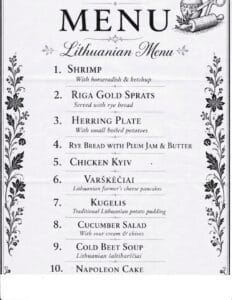
A recent book club had me discuss the novel with its members as we were served the dishes above, all of whose recipes appear in the novel.
Some Reviews of The Seaside Café Metropolis

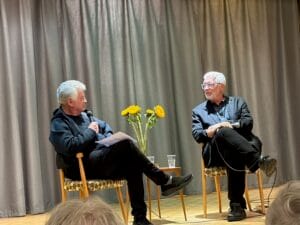
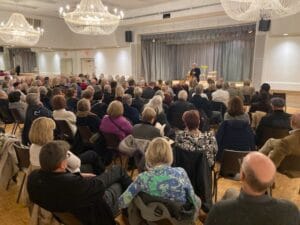
Above  – in conversation with Wodek Szemberg at the October 28, 2025 launch of  my latest novel, The Seaside Café Metropolis and below a long shot of the audience.


Here are 3 reviews of the novel:

1)


Pickle Me This

About / Recently Read  / Definitely Thriving

November 14, 2025

The Seaside Cafe Metropolis, by Antanas Sileika

“How is it possible to live under tyranny? One must create a sort of fantasy world to shield at least part of oneself from the oppression. And under this shield, people can make alternative lives for themselves, real or imaginary ones.” 

There is no seaside at the Seaside Cafe Metropolis, and there is no metropolis either, instead Khrushchev-era Vilnius, Lithuania, to which Toronto-born Emmett Argentine has followed his idealistic socialist mother and still can’t seem to be unravelled from her apron strings, never mind that he’s the one in the kitchen now, or at least overseeing the kitchen, and the rest of his restaurant, the Seaside Cafe Metropolis, which is indeed a cafe, if nothing else. And also the centre of Bohemian life in Vilnius, although there isn’t much competition for that distinction, and Antanas Sileika’s The Seaside Cafe Metropolis is a rich, funny, and quietly poignant chronicle of this most distinguished undistinguished establishment, where KGB agents listen from the basement to microphones installed at the tables so that nobody can ever say in so many words just how much the Soviet reality has failed to lived up to its promise, but also everybody knows, so nobody has to. And in the meantime, Argentine (not in fact from Argentina) contends with informants trolling for dissidents, securing a jazz band, the mediocrity of Soviet champagne, the dramas of his young patrons (the poet, the philosopher, the sculptor, the artist), a visit from Sartre and Simone de Beauvoir, protecting his employees from the terror of the state, and a one unforgettable chain of tragedies involving a lion, each chapter complete with a recipe (“Buckwheat Groats,” “Potato Kugel,” “Herring and Onion on Warm Potatoes”) rounding out this culinary experience, which turns out to be a celebration of community, solidarity, and the transformative power of imagination.


2)

The Seaside Café Metropolis by Antanas Sileika

Miramishi Reader – November 16, 2025 by Alison Manley

There’s a certain wry tone in Soviet comic fiction — sly, humorous, incredibly bleak, resigned, and also still managing to delight in the absolute absurdity of it all. It’s very specific, and if you’ve read any Soviet writers, you’ll know what I mean. This is the tone of The Seaside Café Metropolisby Antanas Sileika – a book published in 2025, but managing to capture the tone of Soviet fiction from these few decades after the formal end of the Soviet Union.

Set in Lithuania in the late 1950s and early 1960s, Emmet Argentine is the son of a Canadian woman who decided to commit to her ideals and go live in Vilnius, the capital of the Lithuanian Soviet Socialist Republic, part of the USSR and still resistant to rule from Russia. Emmet, a trained chef who worked in the top hotels in Toronto, he finds himself an oddity in Vilnius. Useful to the regime, he’s allowed some freedoms, but also toes the line, keeping himself, his mother, and his staff safe. When he’s assigned to run a new café, modelled on the things that people might want from the West, he embraces it, even though the Seaside Café Metropolis is none of the things the name claims it is.

This novel reads more like a collection of connected short stories: each chapter is a self-contained tale about Emmet, the café, and the cast of characters who haunt the place. Each story is shaped around a meal – usually Emmet’s attempts to make something that appeals to Lithuanian tastebuds, reflects the limited ingredients he can get his hands on in the country, and also characterizes the kind of bohemian café he wants to run. Each chapter ends with a recipe for the central dish, usually with some commentary thrown in about how it had to actually be made in Lithuania.

This novel was so darkly hilarious that I spent the whole time reading it and chuckling. It was wildly entertaining and Sileika’s ability for such sly, dark humour is fantastic. Sometimes we need to laugh, and sometimes we need to laugh with a shadowy hint for a shadowy moment. This book is perfect for that latter need.

Details:

Antanas Sileika is a Canadian author of six previous books of fiction, as well as two memoirs. His collection of short stories, Buying on Time, was shortlisted for the Leacock Medal for Humour and the Toronto Book Award, and longlisted for CBC’s Canada Reads in 2016. His books have repeatedly received starred reviews from Quill & Quire and have been listed among the one hundred best books of the year in The Globe and Mail. One of his novels, Provisionally Yours, was adapted into both a feature film and a television serial in Europe. He currently lives in Toronto, Ontario.

Publisher: Cormorant Books (September 27, 2025)
Paperback 8″ x 6″ | 294 pages
ISBN: 9781770868106


3)

49’th Shelf.com

The Seaside Cafe Metropolis, by Antanas Sileika

Cormorant Books

There is no seaside at the The Seaside Cafe Metropolis, and there is no metropolis either, instead Khrushchev-era Vilnius, Lithuania, to which Toronto-born Emmett Argentine has followed his idealistic socialist mother and still can’t seem to be unravelled from her apron strings, never mind that he’s the one in the kitchen now, or at least overseeing the kitchen, and the rest of his restaurant, the Seaside Cafe Metropolis, which is indeed a cafe, if nothing else. And also the centre of Bohemian life in Vilnius, although there isn’t much competition for that distinction, and Antanas Sileika’s The Seaside Cafe Metropolis is a rich, funny, and quietly poignant chronicle of this most distinguished undistinguished establishment, where KGB agents listen from the basement to microphones installed at the tables so that nobody can ever say in so many words just how much the Soviet reality has failed to lived up to its promise, but also everybody knows, so nobody has to.
And in the meantime, Argentine (not in fact from Argentina) contends with informants trolling for dissidents, securing a jazz band, the mediocrity of Soviet champagne, the dramas of his young patrons (the poet, the philosopher, the sculptor, the artist), a visit from Sartre and Simone de Beauvoir, protecting his employees from the terror of the state, and a one unforgettable chain of tragedies involving a lion, each chapter complete with a recipe (“Buckwheat Groats,” “Potato Kugel,” “Herring and Onion on Warm Potatoes”) rounding out this culinary experience, which turns out to be a celebration of community, solidarity, and the transformative power of imagination.


Movie Poster

Here is the poster for the Lithuanian movie adaptation of my novel, Provisionally Yours known as Laikinai jūsų in translation. And below that you’ll find a link to the trailer as well as a few pics. The premiere in Vilnius on November 23, 2023 was a blast!  We’ll see if it can get over here next year.


The trailer is here:


Standing on a Vilnius street by an ad for the film.


On the red carpet at the premiere with lead actress Justina Nemanytė.


The audience for the premiere

*******************************************************************

Provisionally Yours,  will also be adapted in an  8-part TV serial in the spring of 2024. Here is a Lithuanian language newspaper article about it.

Below is a photo of me with the actors and crew on location in the spring of 2023. The director in white is Ramūnas Rudokas and the lead, Simonas Storpirštis, stands beside me. I wish I’d thought to ask after the other names, but it was all in a whirl. See a few more photos on the photos page.


**************************************

In December of 2023 I spent a week in Rome helping my publisher, Del Vecchio Editore, to promote the Italian translation of my 2011 novel, Underground, about anti-Soviet resistance in postwat Lithuania. Becauae of the ongoing war between Russia and Ukraine, interest was intense and the questions at various  events were piecing both in Italian and in English, in Rome and in Naples.


A strange and dramatic cover for the Italian translation of Underground.


A wonderful event hosted by Anne Giardini in Rome, and supported by two embassies.


**************************************************

My latest novel, Some Unfinished Business was published by Cormorant Books  in February of 2023. I am very pleased indeed.

I received a wonderfully supportive description of the work in the introduction to an interview I did with Open Book.

Some Unfinished Business is a novel based on historical events that tell the story of a rhyming assassin, underground resistance, and precarious love in the Soviet Union of the postwar era

The Book Launch of Some Unfinished Business


************************************

Here is a link to my most  recent audio book review on Shelagh Rogers’s CBC Radio 1 show, The Next Chapter.  I have reviewed Marius Kociejowski before, and I thought I’d had enough, but this erudite bookseller with a love for culture has an eye for eccentrics who are more interesting than the mainstream.

***********************************

A Chinese translation of Woman in Bronze,  originally published in 2011, has just appeared .

**************************************

I was in Europe for much of the spring and summer of 2022. I had a few literary readings in Lithuania and in May I  toured the translation of Buying on Time in Italy, translated as Tempus Fugit. Here is a link to some of the events.

I have just signed with the wonderful Italian house that did Tempus Fugit, Del Vecchio Editore, in order to have them bring out a translation of Underground in 2023.

*********************************

And in the meantime, here is a nice Lithuanian language profile of me that just ran on LRT TV. I’m on at about minute 2:20 and you may need to turn on sound.